“Big Promise” headlines always work.
- “How to lose 10 pounds in a week.”
- “5 quick productivity hacks will save you 3 hours a day.” It’s like a magic trick to get people interested. Promise the dream, and they will come.
But with great power comes great responsibility.

Your readers are intelligent. They will figure out if your big promise was clickbait. If you betray their trust, most readers will stop reading, and some will never come back again.
You must convince the readers that your promises are true. You have to sell the dream, not just promise it.
The following ad was a masterclass on attracting readers with a big promise and convincing them that it’s real.
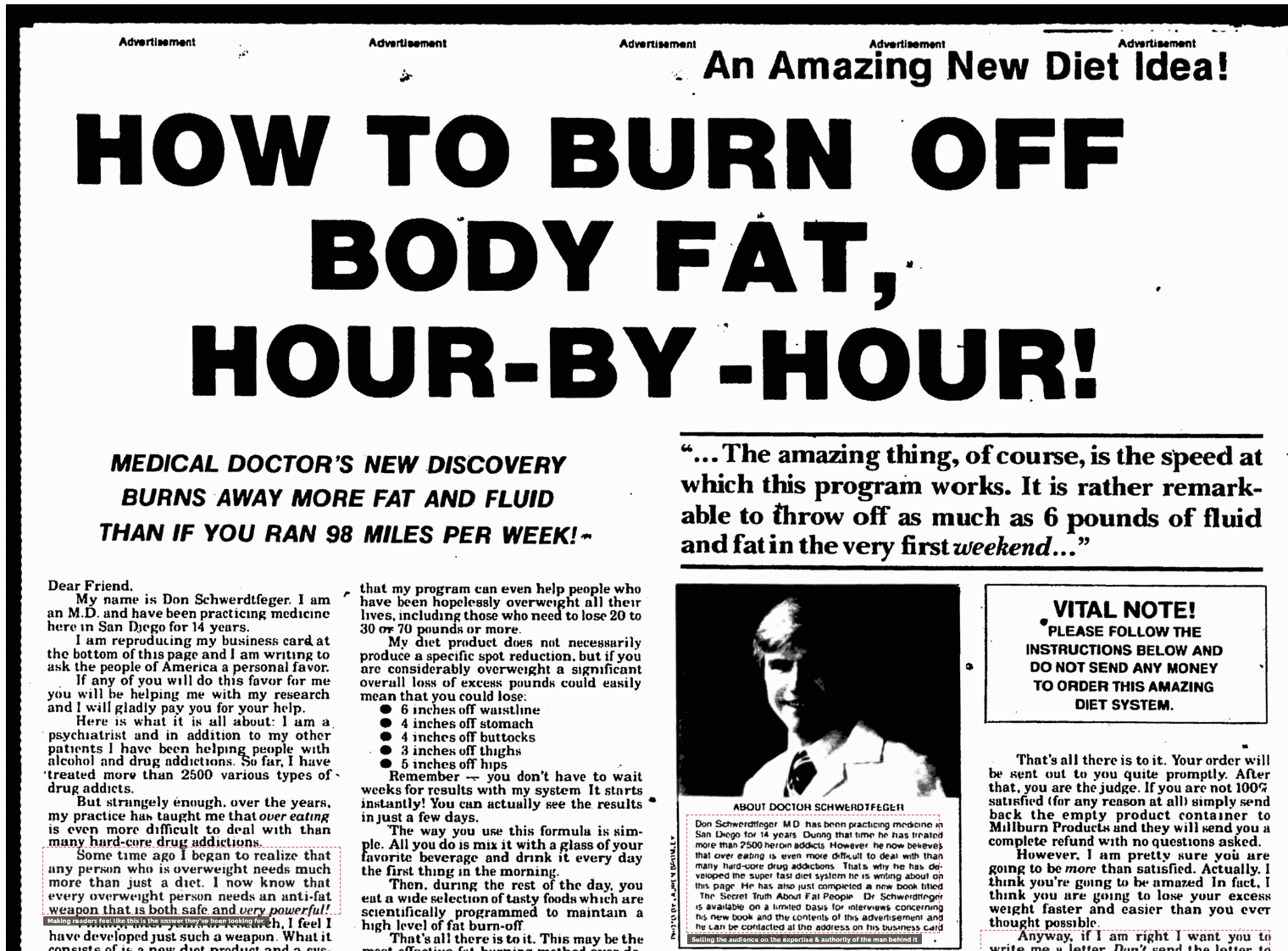
It was published in 1980 and promised quick fat loss with minimal effort.
This is a big claim. Many people struggle with weight, so reading the headline (and subheadline) will make them want to read more. But now it’s time for the copywriter to deliver.
This is how he’s done it.
1/ Authority
Right at the beginning of the ad, we understand who the author is.
- He is an M.D
- He has 14 years of experience
- He treated more than 2500 drug addicts
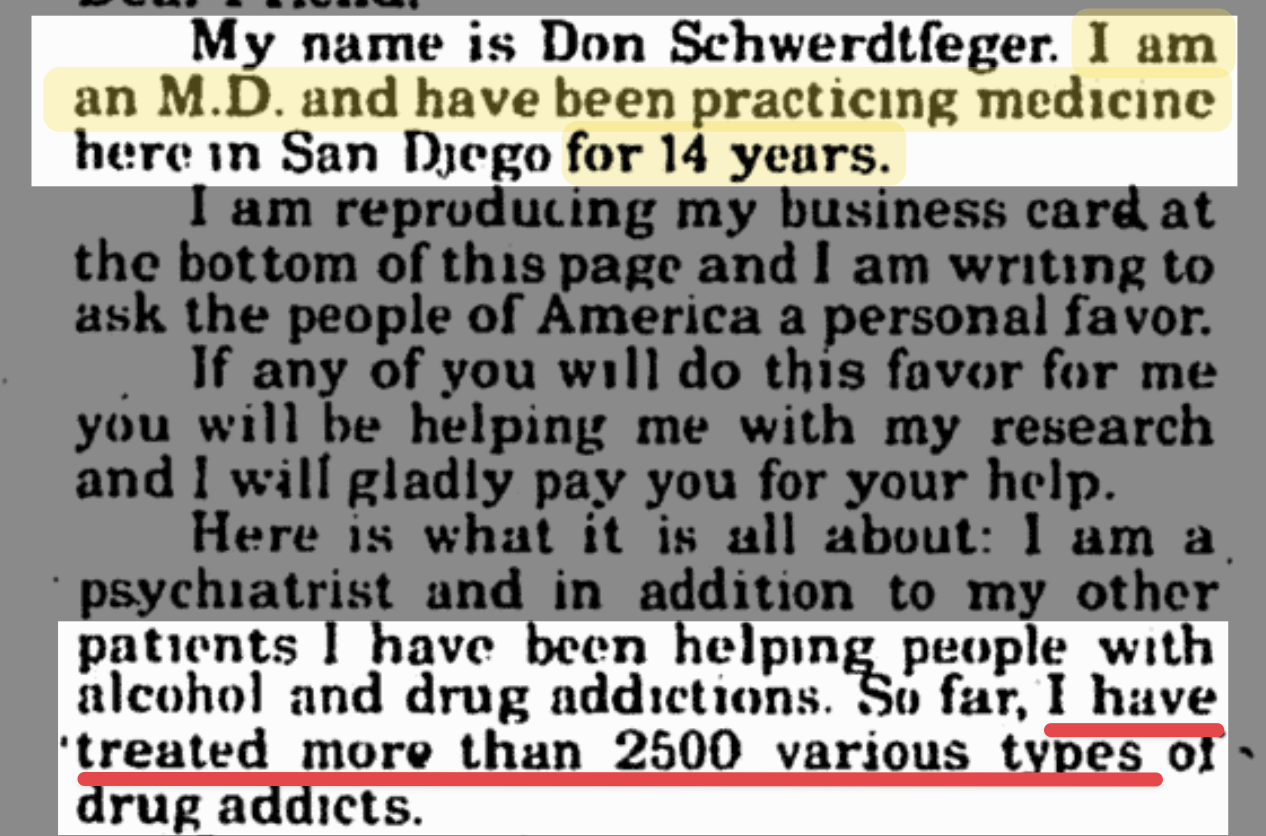
This sets the stage beautifully.
In the reader’s mind, he is now listening to an expert, so the rest of the copy will hold more weight and value.
The author must know what he is talking about, and there is a higher chance that his promise is true.
2/ Specific Proof
You want to share proof that the promise you made has already worked. Show that your product “walks the walk,” and people will be more likely to believe your story.
Check out the paragraph below, where the author mentions multiple times how “many people” tested the program and experienced significant results.
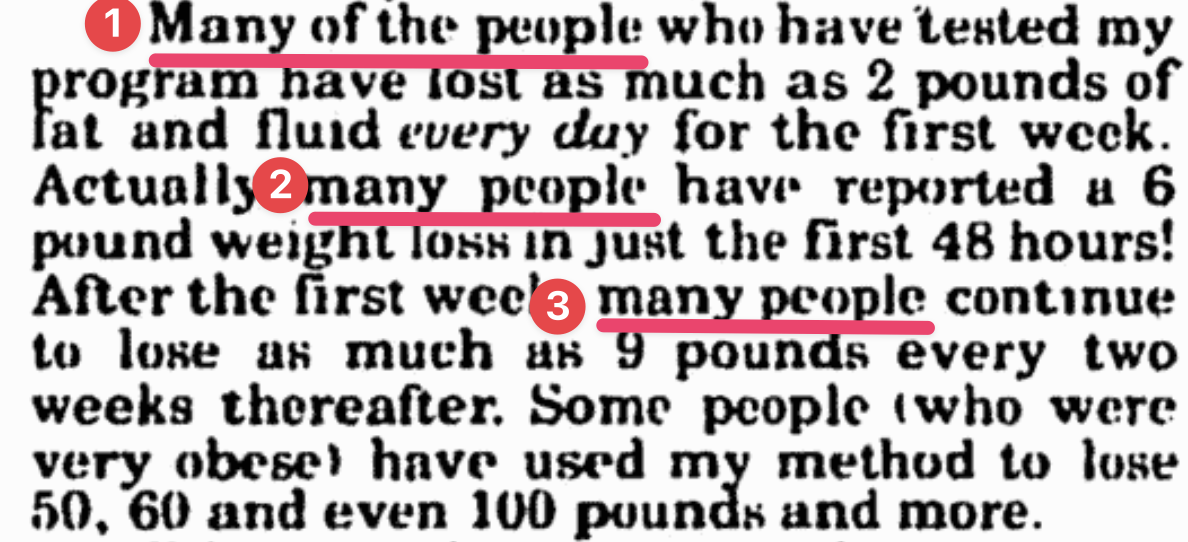
Being specific also helps. He explains how many pounds these people lost and when it happened. This makes the story more believable.
It would have been better if he had been specific about the number of people who had experienced the program instead of saying there were “many people.”
3/ Confort objections
Copywriting is sales.
When you sell something, your prospects will have questions and fears that prevent them from buying. Your job as a salesman is to eliminate the fear and answer the questions to help the prospect make his decision.
The problem is that, as a copywriter, **you can’t see the prospects.**You can’t hear what the reader thinks about what you have written and can’t talk to him like a 1-on-1 salesperson.
The solution?
Get into your customer’s mind and forecast what objections he will have about the product. Then, make sure to face these objections in your copy.
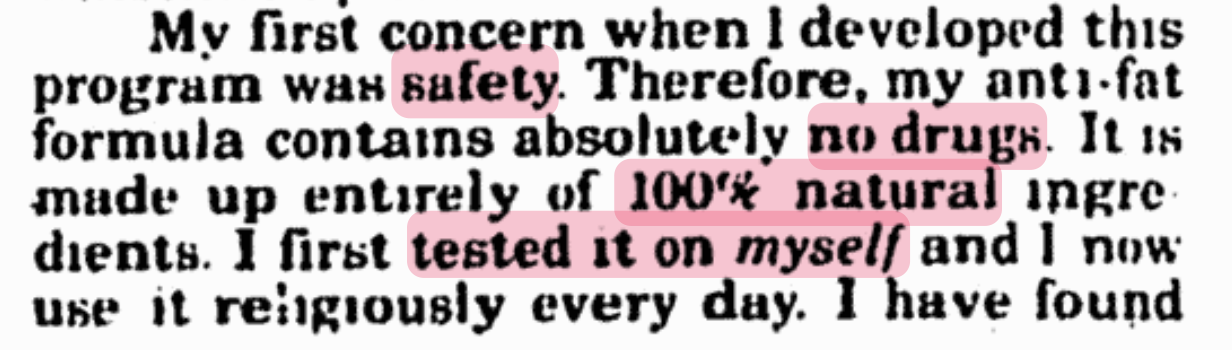
The author of this ad knew that his potential customers would be concerned with the safety of the product.
They must think: “There is no chance losing weight so quickly will come without health risks!”
After a few paragraphs of talking about the product’s benefits, he explained how he made absolutely sure this program was safe.
- It contained no drugs.
- It’s 100% natural
- He tested it on himself.
4/ Rinse and repeat
The author not only uses the concepts above to convince the reader, but he also repeats them multiple times.
The first two columns are mostly repetitions of “reasons you should believe this product works”:
Authority → proof → removing objection → proof → removing objection → Authority.
Sometimes, he is saying the same things. Still, by repeating key points about the product, the author increases the likelihood that the readers will remember the right things when making a purchasing decision.
5/ Uniqueness
These days, we are used to seeing weight loss ads. But back in 1980, that wasn’t the case.
These ads were uncommon, so promising a new way to lose weight attracted readers by default.
The copywriter’s job is to develop a unique angle for the product he sells. It’s getting harder today, but if the copywriter does his research right, it’s possible.
But that is a topic for another post.